
Basics
The Ayurvedic Doctor: Who They Are and What They Do
The word 'doctor' appears on almost every page about Ayurveda: a doctor prescribes treatments, a doctor runs panchakarma, a doctor determines your constitution. Here is who that really is — what and how long they study in India, what happens in a consultation, what they may prescribe, and how to tell a doctor from the therapist who performs the treatment.
Who is an Ayurvedic doctor
The word “doctor” appears so often on pages about Ayurveda that it stops registering: a doctor prescribes treatments, a doctor runs panchakarma, a doctor determines your constitution during an examination. Behind the word stands a specific profession with a specific education, and in India it works rather differently from how many Western websites present it.
An Ayurvedic doctor is a graduate of an Ayurvedic medical college working in a system that the Indian state recognizes on a par with conventional medicine. They see patients, examine them, form a conclusion in Ayurvedic terms and prescribe treatment: diet, routine, medicines and procedures. They are also responsible for contraindications and for making sure that what is prescribed does no harm.
Other titles circulate nearby — “Ayurveda specialist”, “Ayurvedic consultant”, “Ayurveda coach”. They are not synonyms. A consultant may be well read and helpful, but usually has no medical education, and assessing someone’s health is not their job.
How they are trained in India
In India Ayurveda is a state system of medicine with its own ministry, colleges and registers of practitioners. How it is organized is explained in detail in What is Ayurveda, in plain words; here we focus only on the people.
The basic degree is called BAMS — Bachelor of Ayurvedic Medicine and Surgery. It takes five and a half years: the theory of the classical texts, anatomy and physiology, herbal pharmacology, diagnosis, surgery, obstetrics — and clinical practice in the college hospital. After BAMS there are master’s and doctoral programs in which a doctor specializes in a branch: panchakarma, internal medicine, pediatrics, gynecology.
The scale of the system shows in the AYUSH ministry’s figures. As of 1 April 2024 there were 538 Ayurvedic colleges offering the undergraduate program, and nearly 372,000 Ayurvedic practitioners were listed in the registers. This is not a rare profession or an esoteric circle: it is a separate branch of healthcare with its own hospitals and its own stream of graduates. India’s other traditional medicines come under the same ministry, with their own degrees, colleges and registers: a Siddha doctor in Tamil Nadu also studies for five and a half years, on the BSMS program — Bachelor of Siddha Medicine and Surgery.
What happens in a consultation
A consultation with an Ayurvedic doctor is nothing like a spa questionnaire. It is long and very detailed, and a good half of the questions seem irrelevant.
- History. Digestion, bowels, sleep, appetite, thirst, sweating, menstrual cycle, tolerance of heat and cold, usual daily routine, work, stress.
- Examination. Skin, tongue, eyes, build, the condition of hair and nails.
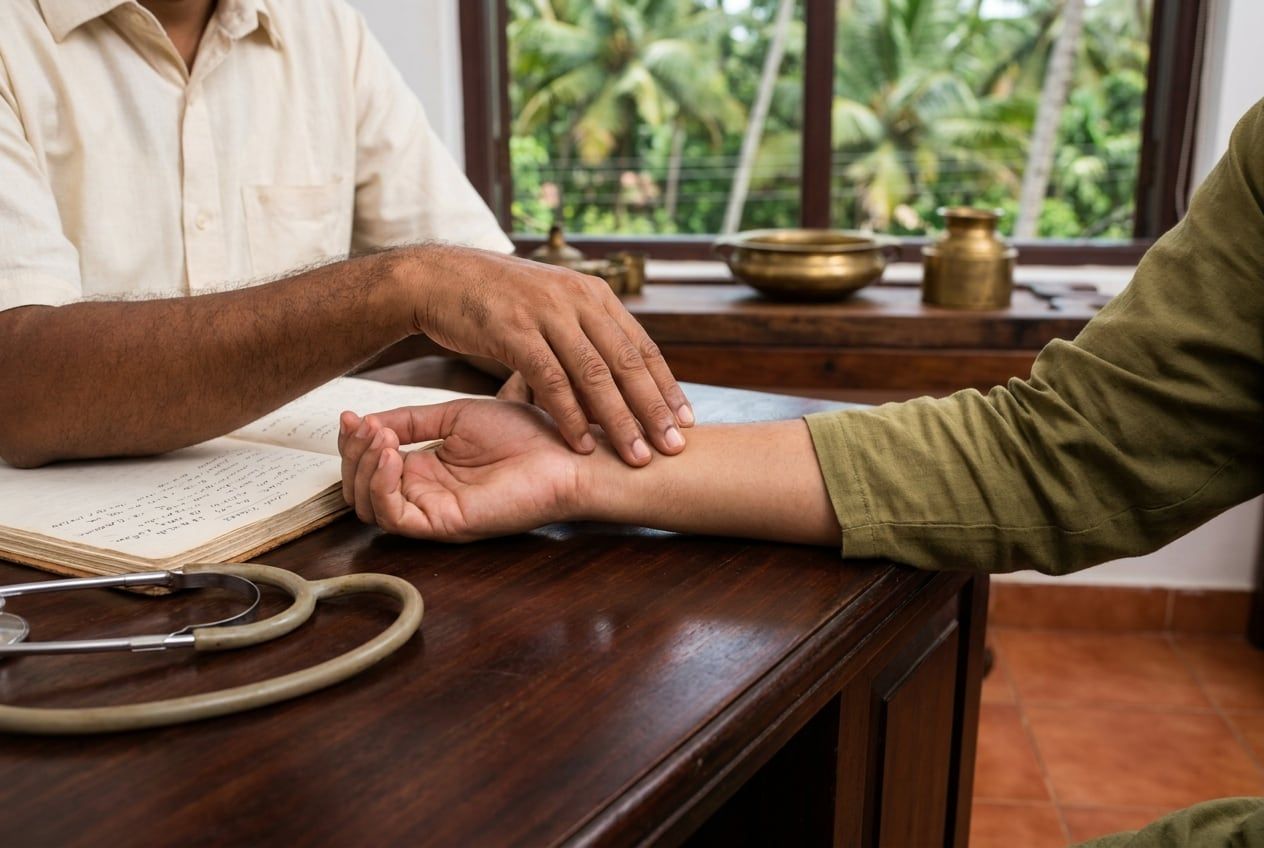
- Pulse. The doctor places three fingers on the radial artery: in the tradition the pulse is read as a separate source of information about the state of the doshas.
- Conclusion. The doctor speaks not of a diagnosis in the usual sense but of which dosha is out of balance, what state digestion is in and what to do about it.
Much here depends on the school and experience of the individual doctor. So what matters is not “is there a doctor” but which doctor and where they trained.
What the doctor prescribes
An Ayurvedic doctor’s prescription is almost never one thing but a combination of four.
- Diet. What to eat and what to avoid, in what form and at what time. The principles are covered in the article on the Ayurvedic diet.
- Routine. When to get up and go to bed, exercise, oil, steam, walks — what Ayurveda calls dinacharya.
- Medicines. Herbal formulations, oils, powders. Some classical formulations contain minerals and metals — such remedies are taken only on a doctor’s prescription and only from a reputable, GMP-certified manufacturer.
- Treatments. Oil, sweating and cleansing procedures — from abhyanga to a full cycle of panchakarma.
The key word here is “prescribes”. Cleansing procedures are not chosen from a catalog: the doctor looks at the person’s condition and decides what to do, in what order and for how many days. The doctor also takes off the program anyone it does not suit — the list of contraindications in Ayurveda is long and covers pregnancy, acute illness, exhaustion and the heart.
A separate part of the doctor’s work is the medication a person is already taking. Herbal preparations can interact with conventional drugs. So bring your list of prescriptions with you and show it to the doctor before the program starts, not after.
Doctor, therapist and massage practitioner
Two different professions work in an Ayurvedic clinic, and they should not be confused.
The doctor examines, prescribes and is responsible for the outcome. The therapist performs the treatment by hand: warms the oil, keeps the pace, watches the person’s condition on the table. They are trained differently and for different lengths of time.
This distinction matters for those coming to study too. An Ayurvedic massage course trains a practitioner who performs treatments confidently and knows the contraindications, and after the final assessment a clinic certificate is issued. The doctor’s path is different: it takes years at a medical college in India.
Why without a doctor a treatment becomes a spa service
The line between an Ayurvedic treatment and a spa ritual runs exactly through the figure of the doctor. A spa usually has a short questionnaire and a choice from a menu; in Ayurveda the treatment is preceded by an examination, and the prescription rests on the person’s condition. More in Ayurveda vs spa: what’s the difference and in the guide to which treatments belong on a spa menu.
This gives a simple rule for choosing. A relaxing oil massage for a healthy person can be done without a doctor — it is enough for the therapist to know the contraindications. But once a course of treatments, cleansing or medicines comes into play, without a doctor’s examination it stops being Ayurveda and becomes a set of pleasant manipulations.
Outside India
The status of the profession changes at the border. In the US, for example, Ayurvedic practice and training are largely unregulated, and no state licenses Ayurvedic practitioners. In other countries local law decides, and an Indian degree does not by itself confer the right to practice medicine outside India.
Hence a practical conclusion for travel: a genuine Ayurvedic doctor with a BAMS is most often found where Ayurveda grew up — in an Indian clinic, not in an office down the street. That is exactly why it makes sense to look for panchakarma programs and training in India.
How to check the doctor before you travel
It takes one conversation on WhatsApp or Telegram. Here is what to ask.
- Is there a resident doctor at the clinic, and what is their name? A name and a degree are a normal question, not a sign of distrust.
- When will the examination take place? Good practice is an examination before the program starts, not after the first treatment.
- Who prescribes the treatments? If the program is “put together by a manager on request”, there is no doctor in the chain.
- What about your medications and diagnoses? A clinic that asks you to send the list in advance is doing things right.
- What happens if a treatment doesn’t suit you? Readiness to cancel and replace a treatment is the mark of a medical approach.
In the school’s programs and courses this part works exactly like that: an examination before the start, the doctor’s prescription, supervision throughout the program. How preparation for cleansing and recovery afterwards work is covered in a separate article.
Worth remembering
An Ayurvedic doctor does not replace your own doctor. In India Ayurveda is a recognized system of medicine, but it has its own descriptive language and its own scope, and with acute conditions, chronic illness and regular medication the decision is made together with conventional medicine, not instead of it.
The sensible arrangement is this: your own doctor knows you are going on a program; the Ayurvedic doctor at the clinic knows what you are taking and in what doses. Then both sides work for you, and neither acts blind.
Sources
Frequently asked questions
Who is an Ayurvedic doctor?
In India it is a graduate of an Ayurvedic medical college with a BAMS degree — Bachelor of Ayurvedic Medicine and Surgery. They examine the patient, form a conclusion in Ayurvedic terms and prescribe diet, routine, medicines and treatments. In India it is a state-recognized medical profession with its own colleges and registers.
What does BAMS stand for?
Bachelor of Ayurvedic Medicine and Surgery — the basic qualification of an Ayurvedic doctor in India. The program takes five and a half years including clinical internship; after it come master's and doctoral programs.
Can an Ayurvedic doctor replace my regular doctor?
No. Ayurveda does not replace conventional treatment and does not cancel prescribed medicines. If you take medication or have a chronic condition, discuss the trip and the treatments with your own doctor as well.
How is a doctor different from an Ayurvedic therapist?
The doctor examines and prescribes; the therapist performs the treatment by hand as the doctor prescribes. These are two different roles and two different trainings: medical college for the doctor, training in treatment technique in a clinic for the therapist.
Do I need a doctor just to have an oil massage?
For a one-off relaxing session for a healthy person, no — it is enough for the therapist to know the contraindications. A doctor is needed when a course of treatments, cleansing or medicines comes into play: the doctor decides what to do and in what order.
Message us
We reply personally, tell you more and help you choose the program and dates. The message is pre-filled — just press Send.
We usually reply within a few hours.