
Basics
The Ayurvedic Diet: Principles and Eating for Your Dosha
Ayurveda hardly divides food into healthy and unhealthy. It asks what the food is, how it was cooked, what it was eaten with, how much, when and by whom. We go through the rules of eating in the classical texts and the principles for vata, pitta and kapha — as a guide, not a diet against disease.
What is the Ayurvedic diet
The Ayurvedic diet is choosing food not by calories or a list of healthy products but for a particular person: their digestion, predominant dosha, age, the season and their current state. There are few rules for everyone, and they are simple: eat warm, freshly made food, in moderation, in a calm setting, and only when the previous meal has been digested. Everything else depends on who is eating.
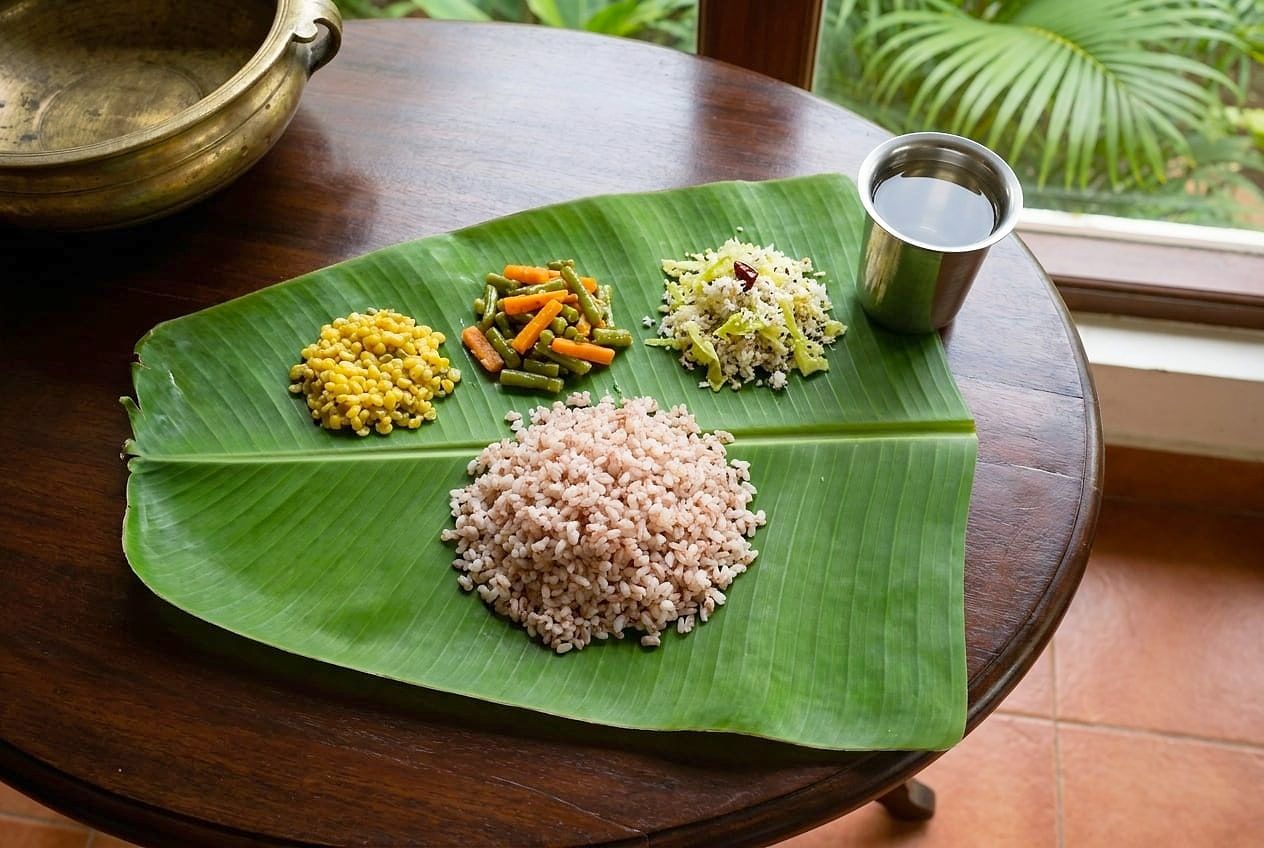
Ayurvedic food, then, is not special products and not necessarily Indian cuisine. Dal, rice with vegetables or kitchari are familiar Indian examples, but the classical texts describe the properties of any food: grains, legumes, vegetables, dairy, meat and fish. An Ayurvedic diet for a modern person is built from the ordinary produce of their own place and season: what matters more is the food’s qualities — warm or cold, light or heavy — how it is cooked and when it is eaten, rather than where it was shipped from.
The classical foundation is the Charaka Samhita, which discusses food in many chapters. Chapter 25 of the Sutra Sthana contains the idea on which the whole subject rests: wholesome food is the cause of a person’s growth and strength, unwholesome food the cause of disease. Below: what exactly the texts consider wholesome and how to use it today.
The eight factors of diet
In the first chapter of the Vimana Sthana, Charaka lists eight factors that decide whether food will do you good. In essence, they are the questions Ayurveda asks of every meal.
- The nature of the food. Whether it is light or heavy: black gram (urad), for example, is heavy according to the text, while green mung is light.
- Preparation. Water, fire, soaking, churning and even the vessel change the properties of food.
- Combination. Together, foods take on properties that none has on its own.
- Quantity. How much is eaten in total and how much of each food.
- Place. Where the food grows and which region it is customary for.
- Time. The season and the person’s condition, including the stage of an illness.
- Rules of eating. How to eat — more on this below.
- The eater. Their constitution and habits: what the body has long been used to.
This list shows why there is no universal diet in Ayurveda. The same lunch will suit a person with weak digestion — agni — differently from one with strong digestion. More in Agni and ama.
The six tastes and the doshas
Ayurveda describes all food through six tastes: sweet, sour, salty, pungent, bitter and astringent. Astringent is the taste that puckers and dries the mouth, like an unripe persimmon. Taste here is not only a sensation on the tongue but a sign of how the food acts on the body.
The Charaka Samhita and the Ashtanga Hridaya describe the effect of tastes on the three doshas in the same way:
- Vata is calmed by sweet, sour and salty. Pungent, bitter and astringent increase it.
- Pitta is calmed by sweet, bitter and astringent. Sour, salty and pungent increase it.
- Kapha is calmed by pungent, bitter and astringent. Sweet, sour and salty increase it.
Hence the classical advice. Charaka considers food containing all six tastes the best habit, and monotonous food with a single taste the worst. A person with one predominant dosha does not exclude tastes but shifts the balance towards those that calm it. What the doshas are and how they work is covered in The three doshas: vata, pitta, kapha. Which of them predominates in you, the dosha test will show.
Rules of eating
In the same chapter of the Vimana Sthana, Charaka gives rules for the healthy and, in some cases, for the sick. They sound almost homely:
- Warm and freshly cooked. Such food, the text says, tastes better, kindles digestion and is digested faster.
- A little fat. Food should not be completely dry: a little oil or ghee — clarified butter — according to the text helps digestion and nourishes the body.
- In moderation. A portion like this does not disturb the doshas or digestion and is digested without heaviness.
- When the previous meal has been digested. The text considers eating “on top of” undigested food one of the main mistakes.
- Neither hurried nor slow. Not on the go, not while talking and laughing, with attention to the food.
- With self-awareness. Notice what suits you and what does not, and eat what suits you.
In chapter 25 of the Sutra Sthana Charaka also names foods he considers wholesome for almost everyone: among grains, red rice; among legumes, mung; among salts, rock salt; among roots, ginger. This is not a list of mandatory foods but an example of how the texts evaluate food.
Meal routine: when and how much to eat
Ayurveda measures how much to eat not in grams but by the strength of digestion. The fifth chapter of the Sutra Sthana of the Charaka Samhita says the right portion is one that is digested on time and does not disturb well-being. Of heavy food the text advises eating no more than a third or half of what you want; of light food, to satisfaction but not beyond.
Mealtimes are tied to the day. Ayurveda assigns midday to pitta, and the digestive fire is linked to pitta, so in modern Ayurvedic practice the main meal is lunch. Dinner is light and early. Breakfast, according to Vasant Lad, depends on the season and digestion: lighter in the heat and with weak agni, more substantial in the cold. Snacks only when real hunger comes, not out of habit.
This adds up to a simple Ayurvedic meal routine:
- Eat at the same times. Irregularity upsets digestion, especially with vata.
- Lunch is the most substantial meal and is not skipped: pitta copes worst with a missed lunch.
- Dinner is lighter than lunch and not late, so the food is digested by nightfall.
- New food when the previous has been digested: lightness, a clean taste in the mouth and real hunger.
How food fits into the rest of the routine — waking, oil, sleep — is covered in Dinacharya: the Ayurvedic daily routine.
Eating with the seasons: autumn, winter, spring, summer
Time, including the time of year, is one of Charaka’s eight factors. The rule is the same as for the doshas: the qualities of the weather and of food add up, and the opposite balances.
- Autumn. In temperate climates this means cold, wind and dryness — vata qualities. Warm, moist food instead of cold and raw: soup instead of salad, enough oil, meals at the same times.
- Winter. According to the texts, the season of the strongest agni; food can be denser and more filling. But kapha accumulates in winter, so it is best not to overdo heavy, sweet and dairy foods.
- Spring. Accumulated kapha brings heaviness and sleepiness. Food is lighter and warmer, with less dairy and sugar.
- Summer. Heat, weaker agni. Food is cool and simple, less pungent and sour, more to drink.
The six Indian seasons do not map literally onto a temperate climate — how to read them for Europe or North America is covered in Ritucharya: the Ayurvedic seasonal routine.
Food combinations: what Charaka says
The subject of “incompatible foods” has gathered a mass of internet rules. It does exist in the classical texts, but it is specific. In chapter 26 of the Sutra Sthana Charaka calls incompatible any food that acts against the body — through its properties, combination, preparation, place, time or quantity.
Two examples from the text are cited most often:
- Milk with fish. According to Charaka, milk is cooling and fish heating, and the combination is considered heavy and harmful to the blood.
- Milk with sour foods. The text calls sour fruits and any sour foods incompatible with milk.
These are positions of the tradition, and we do not add lists to them that are not found in the classics.
Eating by constitution: vata, pitta, kapha
This is what people mean by an Ayurvedic diet for your type, and the logic is simple — opposites balance. The dosha that is in excess in the body is calmed by food with opposite qualities. Vasant Lad stresses an important detail: food should be adjusted to the current state — vikriti — and not only to the inborn constitution, prakriti. On the difference and how to find your constitution type, see Prakriti and vikriti.
- Vata — cold, dry, light. It does well with warm, moist and soft food: cooked rather than raw vegetables, stewed fruit, warm milk, sesame oil. Better to cut back on cold drinks, raw vegetables and dry food.
- Pitta — hot and sharp. It does well with cooling and soft food: sweet fruit, ghee, rice, coconut. Better to cut back on hot chili, sour fruit and salt.
- Kapha — heavy, oily, cold. It does well with light, warm and dry food: vegetables, bitter greens, warming spices, warm drinks. Better to cut back on heavy dairy, sweets, fatty and cold food.
For more detail, with lists of spices, drinks and habits that unsettle each dosha, see the diet sections of the articles on vata, pitta and kapha.
This is a guide, not a diet against disease. Lad himself notes that his tables are general and are adjusted for allergies, digestive strength, season and the degree of dosha imbalance. A rigid “allowed–forbidden” list for one dosha type without an examination usually confuses more than it helps.
Simple Ayurvedic eating rules: where to start
If you boil everything above down to a short list for a healthy person, start with routine rather than a list of foods. These are the rules the classical texts give everyone, regardless of dosha:
- Warm and freshly cooked instead of cold, reheated and yesterday’s.
- A little oil or ghee — food should not be completely dry.
- A portion to match your digestion: lightness after a meal, not heaviness and drowsiness.
- The main meal in the daytime, a light, early dinner.
- Don’t eat on top of undigested food and don’t snack on the go.
- All six tastes over the course of the day, without monotony.
- Calmly and attentively — not in front of a screen and not in a rush.
Adjusting your diet to your dosha and the season makes sense on top of this foundation. The dosha test gives a preliminary picture of your constitution; a doctor’s examination gives a more accurate one.
What this diet does not promise, and when you need a doctor
The Ayurvedic diet does not promise weight loss and does not cure disease. It is a way of eating so that food suits your digestion and routine. Many people feel lighter after changing their habits, but that is not a medical result.
See a doctor — a conventional one and an Ayurvedic one — before changing your diet if you have:
- Pregnancy or breastfeeding.
- Diabetes and other conditions in which diet is part of treatment.
- Stomach and bowel conditions.
- Regular medication. Herbs and supplements can interact with it.
Never stop medication for the sake of a diet.
How it is taught at the school
On Ayurvedashala courses diet is studied together with procedures: in the clinic the doctor prescribes not only oils and treatments but also food for each day of the program. Students see how this works in practice and learn to explain prescriptions to the patient in plain words. Programs are listed on the Training page.
Sources
- Charaka Samhita, Vimana Sthana, chapter 1 'Rasa Vimana': the eight factors of diet and the rules of eating (Charak Samhita Online)
- Charaka Samhita, Sutra Sthana, chapter 26 'Atreyabhadrakapya': the six tastes and incompatible foods (Charak Samhita Online)
- Charaka Samhita, Sutra Sthana, chapter 25 'Yajjah Purushiya': wholesome and unwholesome food (Charak Samhita Online)
- Charak Samhita Online — 'Rasa': the six tastes and their action on the doshas (Charaka Samhita, Sutra Sthana 1/66)
- Ashtanga Hridaya, Sutra Sthana, chapter 1 'Ayushkamiya': the action of tastes on the doshas (translation and commentary, Easy Ayurveda)
- Charak Samhita Online — Matrashiteeya Adhyaya: the fifth chapter of the Charaka Samhita, on the quantity of food
- Vasant Lad. The Daily Routine. The Ayurvedic Institute
- Vasant Lad, Usha Lad. Food Guidelines for Basic Constitutional Types (The Ayurvedic Institute)
Frequently asked questions
Can I lose weight on an Ayurvedic diet?
That cannot be promised. The Ayurvedic diet is not a weight-loss diet: its aim is for food to suit your digestion and condition. Your weight may change as your habits change, but that is not a guaranteed result.
Do I have to be vegetarian to eat according to Ayurveda?
No. The classical texts describe meat, fish and dairy and assign them properties like any other food. Which of these suit a particular person is decided by their condition, not by a blanket ban.
Why does Ayurveda say not to combine milk and fish?
The Charaka Samhita calls this combination incompatible: in Ayurveda milk is cooling and fish is heating, and together they are considered heavy for the body.
How do I start eating the Ayurvedic way?
With routine, not a list of foods: warm, fresh food, the main meal in the middle of the day, a light early dinner, eating when the previous meal has been digested, and no snacking on the go. Adjusting food to your dosha and the season makes sense after that.
How many times a day should I eat according to Ayurveda?
The classical texts give no fixed number. The main rule is to eat when the previous meal has been digested, in moderate amounts and without snacking on the go. How many meals you need depends on your digestion and routine. The main meal goes in the middle of the day; dinner is light and early.
Message us
We reply personally, tell you more and help you choose the program and dates. The message is pre-filled — just press Send.
We usually reply within a few hours.