
Treatments
Abhyanga: the Ayurvedic Warm Oil Massage
Abhyanga is a full-body massage with warm oil that follows a strict sequence: seven positions, strokes in the direction of hair growth, and an oil chosen by the doctor. Here is how the treatment works, who should avoid it, and how it differs from an oil massage at a spa.
What is abhyanga
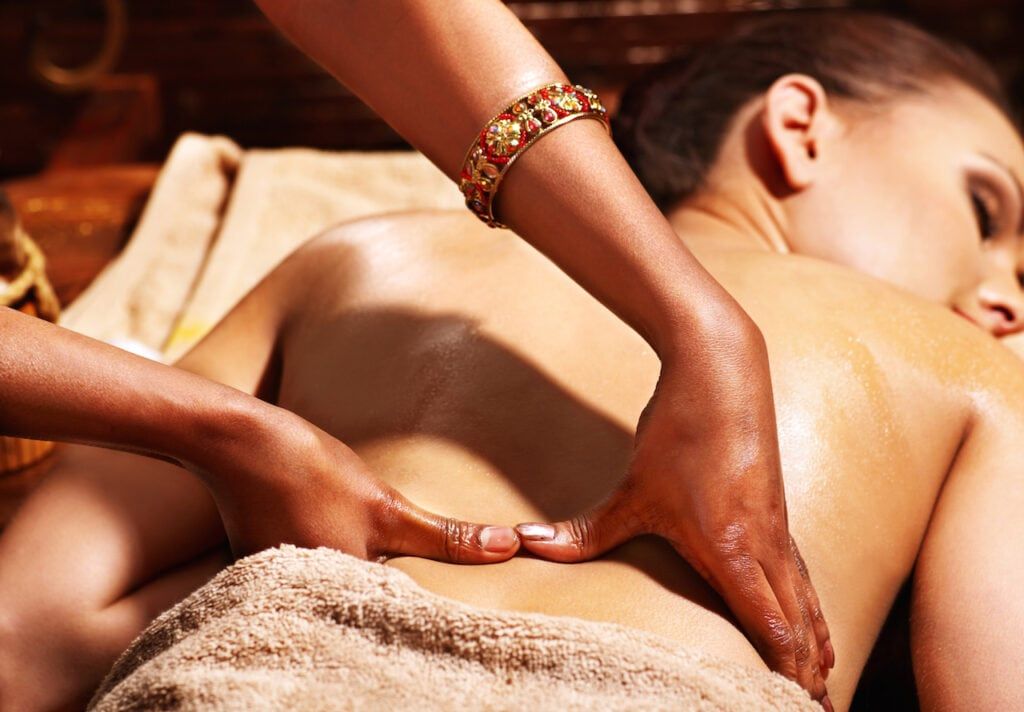
Abhyanga is the application of warm oil to the whole body with a gentle massage that follows a set sequence. The word comes from a Sanskrit root meaning “to anoint” or “to rub in”. You will also see it spelled abhyangam (the Malayalam form common in Kerala) or simply called an “Ayurvedic oil massage” or “Indian full-body oil massage”: Ayurveda comes from India, oil is the heart of the treatment, and the whole body is worked. There is no separate technique behind these names — they all mean abhyanga. In Ayurveda abhyanga is classed as an external treatment and is described in the classical texts: in the Charaka Samhita and the Sushruta Samhita it sits alongside the other daily rules of body care — cleaning the teeth, bathing, exercise.
Abhyanga plays two roles. The first is part of the daily routine: a short self-massage with oil before bathing, which we cover in the article on dinacharya. The same idea of oiling the body appears as snehana, the preparatory oleation stage of panchakarma. The second is a clinical treatment performed by a trained therapist on a doctor’s prescription. In Kerala practice it often opens the treatment day and prepares the body for other procedures, such as shirodhara or pizhichil. This article is about the second role. Where abhyanga stands among the other kinds of Ayurvedic massage is covered in the overview article.
How the treatment works: seven positions
The person lies on a wooden table called a droni. The oil is warmed in a water bath and its temperature is checked on the hand. Work usually begins with the head, ears and feet: the texts single out oil on the head, in the ears and on the feet as the most important.
The body then goes through seven positions. In the teaching sequence the order is:
- Seated, legs extended. Head, neck, shoulders, back, arms.
- Lying on the back. Face, chest, abdomen, arms, front of the legs.
- Lying on the left side. Right side of the body.
- Lying on the front. Back, back of the neck and legs.
- Lying on the right side. Left side of the body.
- On the back again. The front of the body once more.
- Seated again. Closing, as in the first position.
The order varies a little between Kerala schools: the prone position, for example, is sometimes skipped if it is hard for the person. The point is the same — the oil and the hands must reach every part of the body, and nothing is left out.
Each position gets two to five minutes. The figure is not arbitrary. Dalhana, the medieval commentator on Sushruta, describes how oil gradually travels from the hair roots through the skin to the deeper tissues, and allows about 900 matras — roughly five minutes — for the full journey. That is why a hurried rub with oil does not count as abhyanga.
In Kerala clinics abhyanga is often done by two therapists at once: they stand on either side of the table and move in mirrored, synchronized strokes. Both halves of the body receive the same pressure and warmth, and the treatment does not drag on. A single therapist is also common and still gives a proper abhyanga — the sides of the body are simply worked in turn.
Strokes and pressure
The main rule of direction is anuloma, meaning with the direction of hair growth. In practice: long strokes downwards on the limbs, from shoulder to hand and from thigh to foot; circular strokes on the joints; clockwise on the abdomen. Working against the hair growth belongs to a different treatment, the dry powder massage udvartana, which has other goals.
Pressure in abhyanga is moderate. This is not deep tissue or sports massage: the therapist’s hand carries the oil rather than pressing into the muscle. Pressure is adjusted to the person — a thin, dry, anxious body needs softer and slower strokes, a dense and sturdy one can take more vigour. If abhyanga hurts, that is a mistake in technique, not “how it’s supposed to be”.
The oils and why they are warmed
The oil in abhyanga is not a lubricant for the hands but the active substance of the treatment. The doctor chooses it according to the person’s constitution, which dosha is currently out of balance, the season and the goal.
- Tila taila. Plain sesame oil, the base of most Ayurvedic oils. Dalhana’s commentary calls it suitable for all three doshas, which is why it serves as the base.
- Mahanarayana. A complex oil of several dozen herbs on a sesame base, described in the Bhaishajya Ratnavali. Traditionally prescribed when the main complaint is joints and muscles.
- Ksheerabala. A short formula: bala root, milk and sesame oil. A gentler oil, traditionally chosen for vata conditions with an admixture of pitta — heat, irritability, sensitive skin.
- Dhanwantharam. A multi-herb oil from the Kerala compendium Sahasrayogam. One of the staple oils of Kerala practice for vata conditions and in restorative courses.
The oil is warmed for two reasons. The first is the Ayurvedic logic of opposites: vata is cold, dry and mobile by nature, while warm oil is warm, unctuous and heavy, so it balances vata on all three counts. The second is practical: warm oil spreads more easily and the body relaxes under it, while cold oil makes it tense up. The temperature should be pleasantly warm, not hot. How oils are chosen for a condition, warmed, stored and patch-tested is covered separately in Oils for Ayurvedic massage.
What abhyanga is for
According to the Charaka Samhita, someone who regularly anoints the body with oil gets firm, smooth skin, copes better with exertion and fatigue, and is troubled less by vata disorders. The text’s explanation is simple: touch is the domain of vata, the skin is its organ, so oil on the skin acts on vata throughout the body. Sushruta adds soft skin, a good complexion and strength. Oil on the feet is described separately — for dryness, roughness, tiredness and numbness — and oil on the head for the hair and for sound sleep.
In a clinic abhyanga is traditionally prescribed for vata conditions: dryness, stiffness, fatigue, poor sleep, and in restorative courses. It is also part of the preparatory stage of panchakarma.
Who should avoid it
Contraindications are already listed in the Sushruta Samhita, and clinics still follow them. Abhyanga is not done:
- With a fever or at the onset of fever. Including a cold with a temperature and any acute infection.
- With indigestion. Heaviness, nausea, diarrhea, a feeling of undigested food — in Ayurveda these are signs of ama, and according to the text oil in this state only makes treatment harder. For the same reason the treatment is not done on a full stomach.
- Straight after cleansing procedures. After therapeutic vomiting, purgation or a medicated enema.
- With pronounced kapha conditions. A cough with heavy phlegm, severe congestion, swelling, obesity — here the doctor is more likely to choose dry treatments.
- With acute inflammation, broken skin or a skin infection in the area to be massaged.
- With blood clots or clotting disorders — a general restriction for any massage.
- In the first days of menstruation. Most Ayurvedic schools pause oil treatments on these days.
- During pregnancy — only if the treatment is prescribed and supervised by a doctor; standard abhyanga is not given.
With chronic illness, during cancer treatment, after surgery or injury, the decision belongs to a doctor, not to the therapist or the patient. This article does not replace a consultation.
What to expect afterwards
After the treatment you rest for 10–15 minutes and excess oil is wiped off with a warm cloth. Then comes a warm shower or, if prescribed, a sweating treatment. The oil is never washed off with cold water. For the rest of the day it is best to stay warm, not overexert yourself and eat light, warm food.
Usual sensations are warmth, heaviness in the body, sleepiness and soft skin. Sometimes the first sessions leave you a little sluggish; mention it to the doctor — they may change the oil or shorten the time. A single abhyanga is a pleasant treatment, but Ayurveda works in courses: the oil and the routine are prescribed for several days in a row and the response is observed.
Abhyanga for women
There is no separate “women’s” abhyanga: an Indian oil massage for women is the same treatment, the same seven positions, the same anuloma rule and an oil chosen by the doctor. What differs is not the technique but a few circumstances worth knowing in advance.
- The cycle. Most Ayurvedic schools pause oil treatments in the first days of menstruation, both in the clinic and at home. Sessions are scheduled around the cycle, and you tell the therapist which day you are on before the treatment.
- Pregnancy. Standard abhyanga is not given. Any oil treatment during this time only if a doctor prescribes and supervises it.
- After childbirth. The classical texts describe special care for the mother after birth, and anointing with oil is part of it. When to start, which oil and how much pressure is decided by a doctor — especially after a cesarean or any complications; general rules do not apply here.
- Who gives the treatment. In many Ayurvedic clinics in India women are treated by female therapists. If this matters to you, ask when you book.
- Sensitive skin and the face. Oil for the face and head is chosen separately, and any new oil is patch-tested on a small area of skin.
The other restrictions from “Who should avoid it” are the same for women and men.
Abhyanga at home: how to self-massage
Home abhyanga is a short self-massage with warm oil before bathing. In the classical texts it stands not among therapeutic procedures but among the daily rules of self-care, next to cleaning the teeth, exercise and bathing, and it holds the same place in the daily routine. It is not a cut-down clinical treatment but a practice with a different purpose: no seven positions, no second therapist and no medicated oil on prescription.
What carries over from clinical abhyanga to the home version, and what does not:
- The oil is warm. Stand the bottle in hot water for a few minutes, warm one portion and test a drop on the inside of the wrist: pleasantly warm, not hot. A direct flame or a microwave heats unevenly.
- The oil is a base oil, not a medicated one. At home use sesame oil — tila taila, the base of most Ayurvedic oils; Dalhana’s commentary says it suits all three doshas. Mahanarayana, Ksheerabala and Dhanwantharam are chosen according to the person’s condition, season and goal — that is a doctor’s decision, not a shopper’s.
- The directions are the same. Long strokes down the limbs, circles on the joints, clockwise on the abdomen. The anuloma rule — with the hair growth — still applies at home.
- Head, ears and feet first. The texts single them out. If there is no time for the whole body, a short massage of the head and feet is what you keep.
- Then bathe. Wash the oil off with warm water, not cold.
- Regularity matters more than duration. The texts advise oiling the body daily; in ordinary life a few times a week is already a routine.
What the home version lacks is screening. In a clinic you are asked about digestion, temperature, your cycle and chronic illness before the treatment, and it may be cancelled; at home that decision is yours. So the restrictions in “Who should avoid it” apply in full: no oil massage with a fever, indigestion, an acute infection, on broken skin or in the first days of menstruation, and during pregnancy only on a doctor’s prescription. Patch-test any new oil on a small area of skin before first use — how to do it is covered in Oils for Ayurvedic massage.
How clinical abhyanga differs from the spa version
At a spa “abhyanga” often means any relaxing massage with a fragrant oil. The difference comes down to four things. The oil: in a clinic it is a medicated oil on prescription, not one for everyone. The sequence: the seven positions and the direction of strokes are kept, not replaced by a free-form technique. Screening: before the treatment the doctor asks about digestion, temperature, cycle and chronic illness — and may cancel the session. Context: abhyanga is built into a course, followed by rest, diet and other treatments. The spa version can be pleasant, but it is a different service.
On the Ayurvedic massage course at Ayurvedashala, a school of Ayurveda in India, abhyanga is taught hands-on: the body positions, the direction and rhythm of strokes, working in pairs, warming the oil and choosing it with the doctor, contraindications, and how to look after a person after the treatment.
Sources
- Sushruta Samhita, Chikitsa Sthana, chapter 24 — rules of hygiene and prevention (English translation, Wisdom Library)
- Dr Raghuram Y. S. 7 Methodical Positions for Oil Massage — Easy Ayurveda
- Charaka Samhita, Sharira Sthana, chapter 8 (Jatisutriya): care of the mother after childbirth
- National Ayurvedic Medical Association. Abhyanga — the Love Massage
Frequently asked questions
How long does an abhyanga session last?
In the teaching sequence each of the seven positions takes two to five minutes, so the oil work itself lasts roughly 15–35 minutes. With the head, feet and rest afterwards, a session usually takes up to an hour.
Can I have abhyanga during pregnancy?
Not as self-massage and not at a spa. Pregnancy is among the contraindications for standard abhyanga. Any oil treatment during this time is decided only by a doctor.
Is abhyanga suitable for women?
Yes, the treatment is the same for everyone; only the restrictions differ. It is not done in the first days of menstruation, during pregnancy only when prescribed and supervised by a doctor, and after childbirth the doctor decides the timing and the oil. In many Indian clinics women are treated by female therapists — you can ask about this in advance.
Can I do abhyanga on myself at home?
Yes. Self-massage with warm oil before a shower is part of the Ayurvedic daily routine. It is a simplified version: no change of seven positions and no medicated oils. The restrictions are the same — not with a fever, indigestion or acute illness.
Which oil is used for abhyanga?
The base oil is sesame, called tila taila in Ayurveda. In a clinic the doctor more often prescribes medicated oils made on a sesame base, such as Mahanarayana, Ksheerabala or Dhanwantharam, depending on the person's condition, the season and the goal.
How is abhyanga different from an ordinary oil massage?
In abhyanga the oil and the sequence matter more than pressure. The doctor chooses the oil, the body goes through seven positions, strokes follow the direction of hair growth, and the treatment is usually part of a course and has contraindications.
Message us
We reply personally, tell you more and help you choose the program and dates. The message is pre-filled — just press Send.
We usually reply within a few hours.