
Treatments
Pizhichil: Kerala's Warm Oil Bath Treatment
Pizhichil is a Kerala treatment in which several therapists pour liters of warm medicated oil over the body for about an hour without a break, squeezing it from cloths. Where it comes from, how it is done, what it is traditionally used for and why it is only done in a clinic.
What is pizhichil
Pizhichil is a Kerala treatment in which warm medicated oil is poured continuously over the whole body while it is gently massaged. In Malayalam the word means “squeezing”: the therapists dip pieces of cloth into warm oil and wring them out over the body. The Sanskrit names are kaya seka (“sprinkling the body”) and sarvanga dhara (“a stream over the whole body”).
The treatment has classical roots. Among the heat procedures in the Charaka Samhita is pariseka, pouring warm decoctions over the body from vessels. Kerala physicians developed this technique: they replaced the decoction with medicated oil and added massage and a strict sequence. The rules are set down in the Kerala treatise Dhara Kalpa — the same text that describes shirodhara.
Pizhichil is often called “the royal treatment”. In the Kerala tradition it was given to members of ruling families under the supervision of court physicians, the vaidyas. The explanation is prosaic: the treatment uses a great deal of expensive medicated oil and the labor of several people at once.
In ayurveda pizhichil works in two ways at once. It is both snehana — saturating the body with oil — and svedana — heating it to the point of sweating. Normally these two steps come one after the other; here they are combined.
How the treatment is done
First comes the preparation. Oil is applied to the head and ears, the ears are plugged with cotton wool, and a strip of cloth is tied above the eyebrows so that oil doesn’t run into the eyes. A cooling paste or oil is placed on the crown: the head is protected from heat. The body is oiled, as at the start of abhyanga.
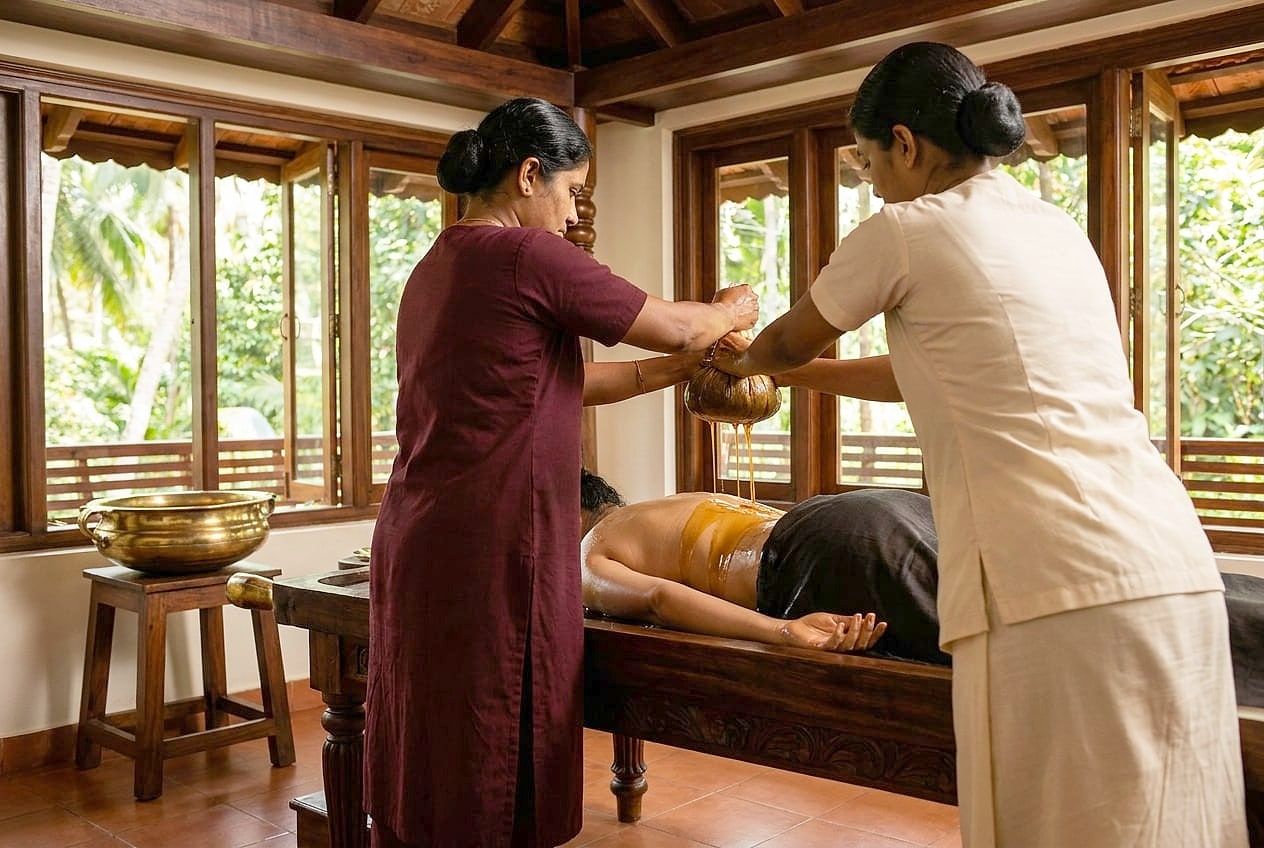
The person sits and then lies on a droni, a long wooden table with raised edges and a drain. Therapists stand on both sides: two, or in the full version four, two for the upper half of the body and two for the lower. One more assistant deals only with the oil: warming it, collecting what runs off the table and returning it to use.
- Cloth. Each therapist dips a piece of cotton cloth into a vessel of warm oil and wrings it out over the body with the right hand, so that the oil runs down the lowered thumb in an even stream.
- Massage. At the same time the left hand gently spreads the oil over the body from top to bottom. The pressure is light: the aim is to distribute warmth and oil, not to knead the muscles.
- Height and rhythm. The oil is poured from a small height — the Dhara Kalpa gives twelve angulas, a little over 20 centimeters — at a moderate pace and without pauses. The therapists work in sync so that both sides of the body receive the same warmth.
- Temperature. The oil is pleasantly hot but not scalding. It is checked constantly, and the person is asked how it feels: oil that has cooled has no effect, and overheated oil does harm.
- Seven positions. The body goes through the same seven positions as in abhyanga: sitting, on the back, on one side, on the front, on the other side, on the back again and sitting again. This way the warm stream reaches every area.
A session lasts 45–60 minutes; the classical descriptions allow up to an hour and a half and suggest going by the appearance of a light sweat. A course is 7, 14 or 21 days, daily or every other day. Five to six liters of medicated oil are prepared for the treatment; it is collected, reheated and reused for several days, then replaced.
The oil is prescribed by the doctor. In Kerala practice it is most often dhanwantharam for pronounced vata conditions, ksheerabala when there is an element of pitta, or other oils according to the person’s condition. Sometimes ghee or a blend of oils is used. What these oils are and how they differ from base oils is covered in Oils for ayurvedic massage.
What pizhichil is traditionally used for
Pizhichil is above all a treatment for vata conditions. Vata is dry, cold and mobile by nature; warm oil in large quantities is its opposite on all three counts. So in the Kerala tradition pizhichil is prescribed:
- For joint and spine conditions. Stiffness, age-related wear of the joints, chronic lower back and neck pain — outside of flare-ups.
- In recovery after injury. Restricted movement after fractures, the after-effects of ligament and muscle injuries and bruises.
- For neurological conditions. The after-effects of stroke, paresis, neuropathies — as part of comprehensive treatment managed by a doctor.
- In restorative courses. Dryness, accumulated fatigue, age-related changes — when the person’s general condition allows heating.
Pizhichil is not used as a stand-alone remedy: it is combined with internal medicines, diet and other treatments. A related heat treatment is described in our article on kizhi.
Who should not have it
Pizhichil is a heat treatment, and all the classical restrictions on svedana apply to it. It is not given:
- During acute fever and infections.
- With digestive disorders. Diarrhea, indigestion, nausea, signs of ama. The texts are explicit: the doctor first restores digestion, and only then are oil treatments prescribed, otherwise the condition will get worse.
- With a cough and difficulty breathing, or pronounced kapha conditions.
- In acute inflammatory and painful conditions, including a flare-up of joint inflammation.
- During pregnancy.
- With bleeding or a tendency to bleed.
- With jaundice, ascites, marked weakness and exhaustion, or a tendency to faint.
- With alcohol dependence — this, too, is on Charaka’s list.
- With pronounced pitta conditions — heat, burning sensations, inflamed skin.
The doctor is especially cautious with people who have diabetes, high blood pressure or heart disease: prolonged heating and fluid loss are risky for them. Charaka specifically instructs that during any heat treatment the eyes and the heart area must be protected from overheating. The decision is always made by a doctor after an examination. This article does not replace a consultation.
What to expect afterwards
After the treatment the body is gently massaged once more and the oil is wiped off with a towel. A pinch of herbal powder, rasnadi churna, is rubbed into the crown. The person rests in a warm room out of any draft and then washes with warm water. The doctor may prescribe a herbal decoction to drink and light, warm food — thin rice porridge, mung bean soup.
The signs of a correctly done treatment, according to Charaka: chilliness, pain and stiffness go away, and the body feels soft and light. The signs of excess are strong thirst, burning, dizziness, weakness and a faint voice; in that case the treatment is stopped and the doctor informed.
During the course and for some time after it you are advised to protect yourself from cold and sun, avoid physical strain, not sleep during the day, and wash with and drink only warm water. Pizhichil is not a “one-off massage”: it is a course you need to clear time for.
Why it is a clinic treatment, not a spa one
Pizhichil rarely appears on a spa menu, and not by chance.
- The volume of oil. Liters of medicated oil per person, which must be stored, warmed, collected and replaced on time. You can’t economize on this without changing the essence of the treatment.
- Temperature control. The oil must stay equally warm for a whole hour over the whole body at once. That takes a dedicated person and constant checking. A mistake means either a useless treatment or a burn and overheating.
- The team. Two to four therapists who work to one rhythm and understand each other without words.
- The doctor. Heating the whole body is a strain. The doctor decides whether a person can have pizhichil, chooses the oil, the duration and the course, watches the reaction and adjusts the prescription. Pizhichil is usually part of a larger program, such as panchakarma, rather than standing on its own.
On the one-month course in Kerala, students learn pizhichil in the clinic as part of a team: preparing the table and the oil, working with the cloth, keeping a synchronized rhythm, the seven positions, temperature control, the signs of sufficient heating and of overheating, aftercare — and the rule that the treatment never starts without a doctor’s prescription.
Sources
- Kerala Tourism (Department of Tourism, Government of Kerala). Pizhichil — the Panchakarma procedure
- Ahalia Ayurveda Medical College Hospital. Kaya Seka (Pizhichil)
- Dr Raghuram Y. S., Dr Manasa. Pizhichil, Kaya Seka: benefits, procedure (with references to the Dhara Kalpa treatise) — Easy Ayurveda
- Charaka Samhita, Sutra Sthana, chapter 14 'Sveda' — on sudation (heat) procedures (Charak Samhita Online)
Frequently asked questions
How much oil is used in one pizhichil session?
Usually 5–6 liters of medicated oil are prepared for the treatment. The oil is collected from the table, reheated and reused over several days, then replaced with fresh oil.
How long does pizhichil take, and how many sessions are needed?
A session usually takes 45–60 minutes, and up to an hour and a half in the classical descriptions. A course runs 7, 14 or 21 days, daily or every other day; the doctor decides how long.
How is pizhichil different from abhyanga?
In abhyanga the oil is applied and rubbed in by hand. In pizhichil the oil flows over the body in a continuous warm stream for the whole session, so the effect of the oil is joined by gentle heating up to a light sweat. Many times more oil is needed, and two to four therapists.
Can pizhichil be done at home or in a spa?
No. It takes liters of medicated oil, a special table with a drain, constant reheating and a well-coordinated team, and heat treatments have serious contraindications. Pizhichil is done in a clinic, on a doctor's prescription and under a doctor's supervision.
Why is pizhichil called the royal treatment?
According to Kerala tradition it was given to members of ruling families under the supervision of court physicians. The reason is clear even without legends: the treatment uses a lot of expensive medicated oil and needs several people working at once.
Message us
We reply personally, tell you more and help you choose the program and dates. The message is pre-filled — just press Send.
We usually reply within a few hours.